
KYIV COMMUNITY RECOVERY FORUM
PRESS RELEASE
Narodna Rada of Ukraine · 17 June 2026 · Kyiv
KYIV COMMUNITY RECOVERY FORUM: OVER 200 PARTICIPANTS, 49,979 PROJECT NEEDS AND CONCRETE STEPS TOWARD RECONSTRUCTION
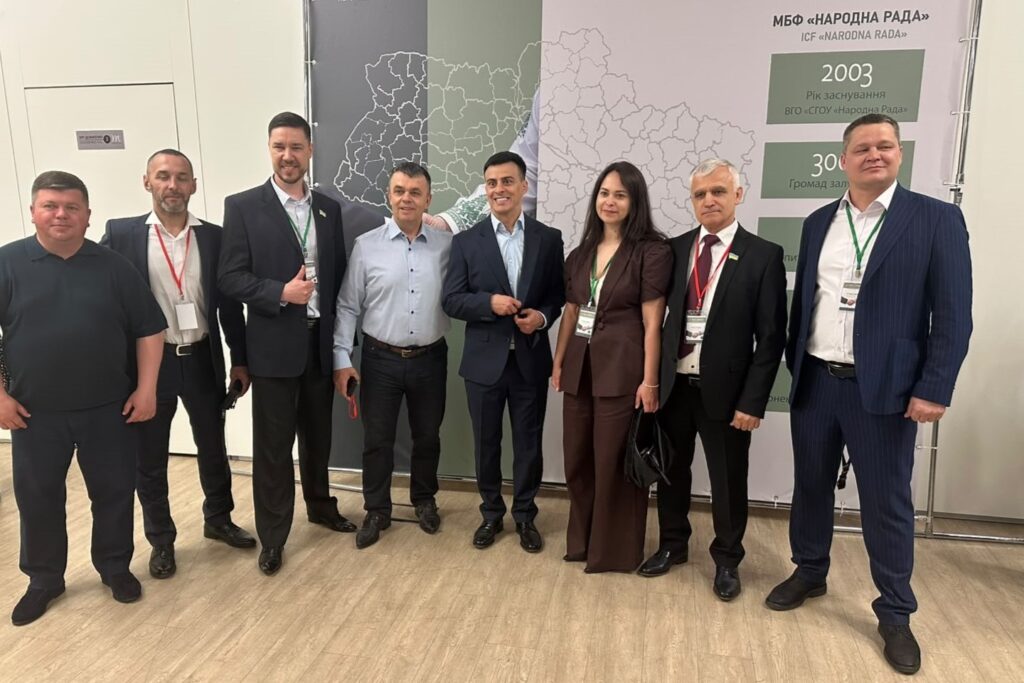
On 17 June 2026, the Community Recovery and Reconstruction Forum took place in Kyiv at the Mercure Kyiv Congress Hotel, organised by the Narodna Rada of Ukraine. The event brought together over 200 participants — heads of territorial communities from across Ukraine, representatives of international organisations, donors and experts — for an open dialogue on the real needs of communities and the mechanisms to address them.
ABOUT THE FORUM
The Forum provided a unique platform for community leaders to present their project needs directly to international partners.
The Forum was moderated by Nadiia Lukashevych, Chair of the Narodna Rada of Ukraine. The official opening was delivered by Volodymyr Onyshchuk, President of the Narodna Rada.
SCALE OF DESTRUCTION: DATA AND FIGURES
An analytical report on the state of Ukraine’s recovery was presented at the Forum, recording the unprecedented scale of losses caused by Russia’s armed aggression:
- 116,165 km² temporarily occupied — 19.25% of Ukraine’s territory, covering over 2,500–3,000 settlements across 8 regions.
- Approximately 236,000 residential buildings damaged or destroyed — 14% of all housing stock; direct losses exceed USD 61.6 billion.
- Over 3,500–4,000 educational institutions affected; losses in the education sector exceed USD 17.7 billion.
- 1,600–1,800 medical facilities damaged or destroyed; total sector losses — USD 15.5 billion.
- Over 23% of territory potentially mined; demining by Ukraine’s own forces alone would take over 20 years.
CLS UKRAINE: 49,979 PROJECT NEEDS
A dedicated session presented the findings of the CLS Ukraine analytical platform. Based on data from 689 communities across 24 regions of Ukraine, 49,979 infrastructure project needs were collected and systematised.
Top priorities by research findings:
- Housing: 26,549 needs — 65% of the detailed structure.
- Engineering structures and municipal infrastructure: 9,156 needs — 22.4%.
- Education: 3,796 needs — 9.3%.
- Healthcare, rehabilitation, heating and energy resilience.
The highest concentration of needs was recorded in Zaporizhzhia region (32.5% of the total base). Iryna Karashchuk, representative of CLS Ukraine, stressed the need to develop a library of replicable project solutions adaptable to different types of communities — frontline, de-occupied, rear-area and rural.
VOICES FROM THE COMMUNITIES
The Forum gave the floor directly to leaders of communities affected by the war.
- Konotop City TG (Sumy region): Despite damage to energy and medical infrastructure, the community continues to operate — it has launched 13 solar power plants with a total capacity of 307 kW and the region’s first pilot wind energy installation. Priority projects: thermal modernisation of two buildings of the Central District Hospital named after Academician Mykhailo Davydov, with a total value of EUR 10.6 million.
- Tsarychanka TG (Dnipropetrovsk region): The community hosts internally displaced persons and is implementing projects for housing restoration, inclusive transport and strengthening municipal capacity. “We are not asking for charity — we are offering partnership,” the community representative emphasised.
- Pokrovsk Settlement Military Administration (Dnipropetrovsk region): Having suffered near-total destruction — 90% of communal infrastructure — and forced evacuation, the community presented a reconstruction concept based on the principles of energy independence, accessibility and digitalisation. Svitlana Spazheva, Head of the Military Administration: “Recovery cannot be a copy of the past. We are building a new community.”
- Sviatoshyn District, Kyiv: Since the start of the full-scale invasion, nearly 500 residential buildings have been damaged in the district, while the population has grown to 400,000 due to 43,400 internally displaced persons. District Head Heorhiy Zantaraia presented needs for the capital reconstruction of housing, shelters and educational infrastructure.
- State Enterprise “Ukrderzhbudekspertyza”: Vitvytska Tetyana Hryhorivna is the director of State Enterprise “Ukrderzhbudekspertyza” and a highly qualified specialist in the construction industry with many years of experience. She has over 40 years of experience, and in 2024 she received a master’s degree in public administration. She has qualification certificates of an expert, a technical supervision engineer and a consultant. In 2011 she was awarded the honorary title “Honored Builder of Ukraine”.
- Podilskyi district, Kyiv: Head of the Podilskyi district state administration in the city of Kyiv Nakonechnyi Volodymyr Mykhailovych, historian by profession, candidate of historical sciences. For a long time he worked at the Kyiv National University of Culture and Arts (KNUKiM) as an associate professor of the department of international relations. He signed a memorandum on support for IDPs with the Seversko-Donetsk MBA, which provides for humanitarian, legal and advisory assistance to people who were forced to leave their homes due to the war.
- Dubno TG (Rivne region): Head of the Dubno TG, Vasyl Mykhailovych Antonyuk (serving as Dubno mayor for the fourth term, starting in 2010), gave a report. During his speech, District Head spoke about the challenges faced by the community as a result of the war, and presented projects for the development of social, educational, and municipal infrastructure.
DECENTRALISATION AS THE FOUNDATION FOR RECOVERY
A dedicated presentation at the Forum addressed Ukraine’s decentralisation reform as the foundation of the country’s resilience. Since 2015, 1,469 capable territorial communities have been established — they served as the first line of support during the war and will become the primary sites for post-war reconstruction. Decentralisation is a fundamental EU requirement and one of the key indicators of Ukraine’s capacity to implement structural reforms.
THE CLS PLATFORM AND THE COORDINATING ROLE OF THE NARODNA RADA
The Narodna Rada Platform was identified as the central coordination tool for recovery — a digital system uniting 4,600 organisations and 1,339 communities. CLS Ukraine provides centralised project classification and monitoring, preparation of “investment-ready” packages for donors and transparent tracking of fund utilisation.
Help Ukraine GmbH acts as an operational partner, providing procurement support, bureaucratic assistance for donor companies and project implementation across energy, education and rehabilitation sectors.
“Recovery in Ukraine is not only about concrete and infrastructure. It is about people, dignity, belief in life and shared responsibility. We approach our partners not as donors, but as equal participants in a common future.” — Volodymyr Onyshchuk, President of the Narodna Rada of Ukraine
Narodna Rada of Ukraine · narodnarada.kyiv.ua
Forum materials, presentations and photographs available on request.